|
Production
The filming of Muffin Man
took place over the course of 25 days in February, 2003. The
majority of the dramatic portion of the film was shot over 10
days on a Seattle-area soundstage. The reminder took a skeleton
cast and crew to the outlying suburban parks and the Cascade
mountains.
The unique ... girth of the
cast, however, created an unusual situation for the director.
"As a director, I felt confident,"
Eisner explained (even though it was her first feature length
film), "but as a physician, I was nervous."
The health of the cast was
of constant concern to Eisner.
"It’s no myth that obesity
is associated with heart problems and stroke," she explained,
"and I just hoped I wasn’t pushing our luck. It’s ironic to
think that the defibrillator on set was non-functional - 'for
safety' ".
The film schedule had been
pushed out 3 weeks to accommodate Mike Short’s (T-Bone) surgery.
He’d had a large, necrotic, non-healing wound on his leg which
required a skin graft only weeks before shooting. Fortunately
he limped into the studio as planned, and, with some TLC, completed
the shoot.
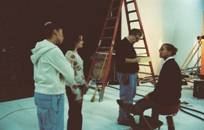
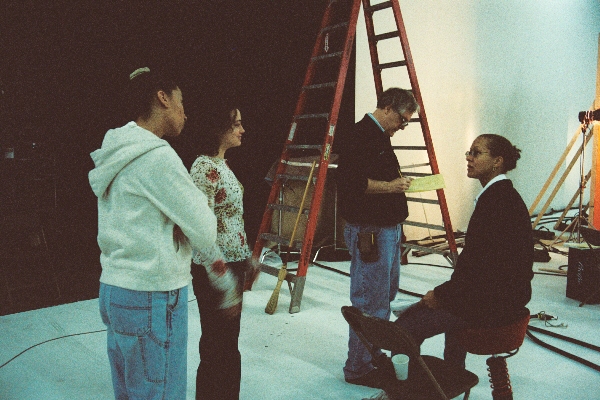
The Crew takes a break during filming
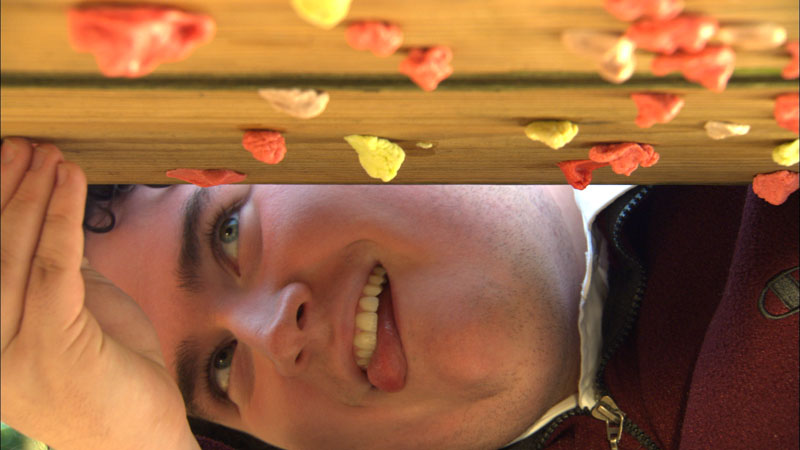
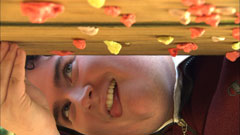
Ben looks for gum under a park bench
As might be imagined food,
created several issue with the shoot. It was, however, made
clear on the first day that all food on set was off limits.
Food props alone amounted to several thousands of dollars of
the productions budget. There were concerns about expired food
and problems with continuity.
"It wasn’t easy," she said.
"But we got lucky with the casts’ attitude, the health of the
cast and the weather," said Eisner, "There were several back-up
plans for shooting the love montage if it rained, but the beautiful
light we captured during those 3 sunny days in February was
amazing. It gave such an ethereal feel to the touching moments
in the love story."
The weather for the tug of
war scene was not as nice. The short, frigid days, of a Pacific
Northwest winter created a compact shooting schedule and cold,
stiff actors. Temperatures for the 3 day scene ranged from 28
to 50 F and the costumes did not included heavy coats.
The days began with a hot
breakfast in the hosts’ garage at 5:45 a.m. and set-up for the
scene. Shooting began at the first suggestion of daylight.
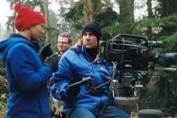
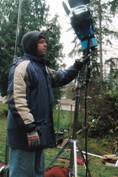
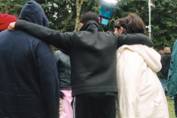
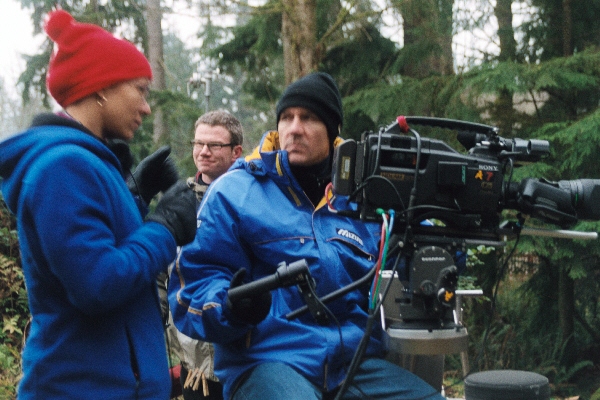
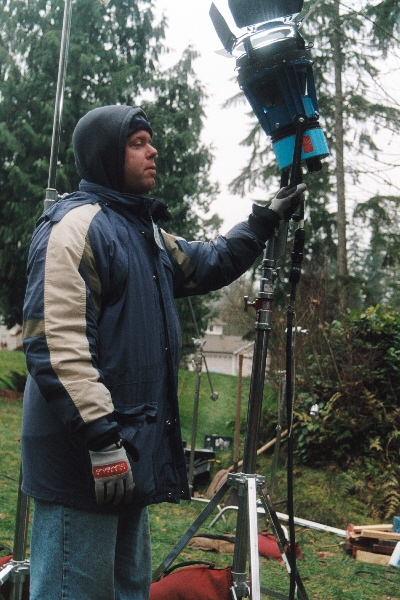
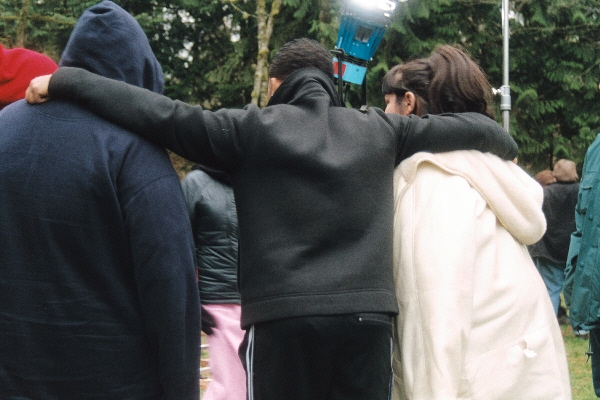
Shooting the "Tug of War" scene on a cold February Morning
"It was cold ... freezing,
really," said Eisner, "but it didn’t rain and, again, the light
was perfect. We got that filtered, gray, misty light so unique
to the region and, more importantly, it didn’t change during
the shoot. I think it lent a certain tension and foreboding
to the scene that couldn’t have been achieved in bright sunlight."
The actors rehearsed in a
heated trailer and darted to the set for each set-up. Once there,
they waited in parkas ... near heat lamps. Anyone not actively
working was assigned to hold a heat lamp on an actor. The average
temperature was barely above freezing.
"It was so miserable," recalled
Porras, "and yet I feel like a total wimp since we actors got
to go inside periodically and everyone else was in the frigid
cold the whole day. It was bone-chilling. When I was out there
I would stand behind the cart of pastries and sneak bites of
the muffins and bear claws. I wonder if anyone ever noticed."
"The actors were stoic and
wonderful," said Eisner. "Even under those intense conditions,
they geared up for the scene and gave it their all. It helped
inspire me to make a great film for everyone."
The light changed and it
began raining during the wrap party.
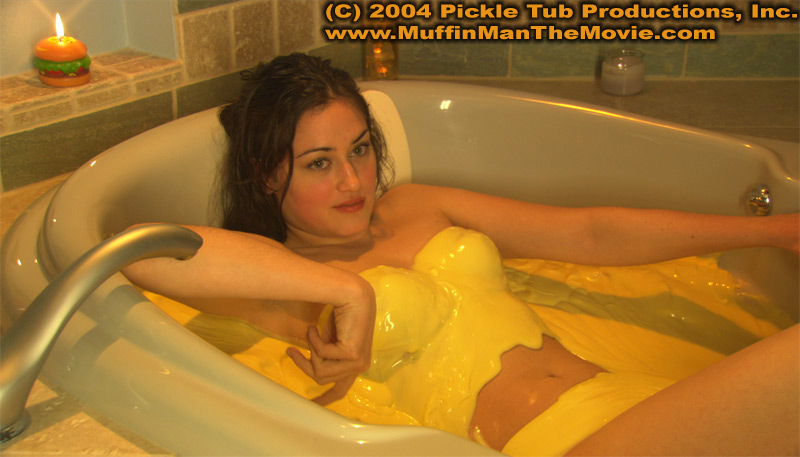
The sex fantasy pudding scene
was, predictably, one of the stranger scenes to produce. The
scene was shot in the Master Bathroom of Eisner's home. After
the grip blacked out the skylight, Eisner banished everyone
but Michelle Porras (Hope) and Randy Peck (the DP) from the
room. Then Eisner proceeded to cover the actress in vanilla
pudding.
"It felt so wrong," said
Porras, "and even though the pudding was room temperature, it
felt cold."
"Michelle was a bit anxious
about the scene so I wanted to put her at ease," Eisner explained.
"However, I was also pouring pudding on her at the same time,
so she could only relax in spurts. When the cold pudding hit
her skin she would let out an ear-piercing shriek and then giggle."
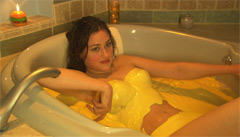
Michelle Porras (Hope) wears the latest in pudding fashion
The effect this had on Ben
and the crew outside the room was to send them immediately pacing
... part worried, part titillated - about the adjoining room.
"The inherent nature of the
entire shoot could have made for some awkward situations," said
DP, Peck. "Of course the actors knew the subject matter going
in, but that didn't guarantee that once the camera started rolling
they wouldn't be apprehensive about what they were doing. They
proved to be true professionals and did a great job. And I think
they had a good time."
The documentary portion of
the film was less dependent on acting and weather and more dependent
on creativity and scheduling.
The studio work was crammed
into 3 days of shooting. Eisner had created an intricate schedule
of alternating still and action shots that kept the small crew
busy.
"I think I worked harder
in there than anywhere." said DP, Randy Peck.
"It came down to time and
money ... both of which were running out." Eisner explained.
"We had to be very efficient."
In addition to the studio
work, there was selection of stock footage and creation of the
custom animations. Over a 9 month period, Eisner drew story
broads for all of the animations and coordinated the work of
four animators in four different states. In addition, she acquired
or created almost every prop. The notable exception was the
life-size 'stone Muffin Man' statue created by Seattle’s Art
Horse studio. The statue still sits in a loft in Eisner’s home.
"My favorite prop is the
baby bottle made out of a grenade." said Eisner. "It’s such
a shocking reminder of where our society is headed and why I
made this film."
|