|
Production Design
Production Design was an
integral and critical component of the pre-production process.
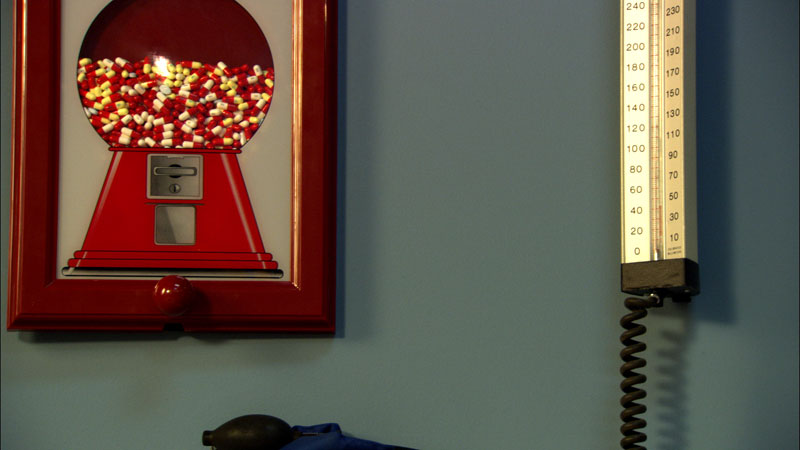
The "medical device wall"
in Jack’s apartment was an aspect of production design conceived
during the writing of the script. It began with the idea of
a gumball machine that dispensed medication and it evolved from
there.
Jack’s daily medication is stylishly and conveniently
dispensed on the wall next to his blood pressure monitor
"I wanted to make a visually
appealing space that conveyed the Muffin Man’s adaptive nature,"
explained Eisner, "but which also depicted the inescapable medical
problems associated with obesity."
Eisner had originally envisioned
a much wider array of medical devices filling the room ... including
fitting Jack with "CPAP" - a device used to treat sleep apnea
(a condition commonly associated with obesity in which the extra
fatty tissue around the neck of obese people results in periodic
cessation of breathing).
"It may not seem like it,"
said Eisner, "but in this regard, I really managed to keep myself
in check."
In the early stages of pre-production,
the production company had somewhat naive hopes of landing a
food sponsorship. However, after calling about a dozen
companies, they realized they were always stopped dead in their
tracks with one simple question: "Will the film portray the
product in a positive light?"
"We didn’t want to be sued
for defamation ... or be held liable for infringing on anyone’s
copyright," said Executive Producer, David Workman.
"Can microwave pork rinds
be portrayed in a positive light?" mused Eisner.
The production decided to
go with completely fictitious brand labels for everything (except
the Blue Dog Bakery Low Fat Dog Food and Philips Heart Start
Home Defibrillator). Culpepper created and fabricated over 30
of these labels for the film
Since the Muffin Men were
theorized to have spent most of their time sitting at home,
the designers wanted the living space to reflect the imagined
food-centric view of the species.
Michael Culpepper and Jessica
Eisner came up with the concept of a fast-food apartment, "Like
he’s living in a mini-mart," explained Culpepper. An industrial
style soda pop dispenser and refrigerator, and food warming
lamps were gleaned from a Seattle restaurant supply store. The
floor lamp is a modified order-wheel full of take-out menus
and a winning bid on eBay led to the addition of a hot-dog rotisserie.
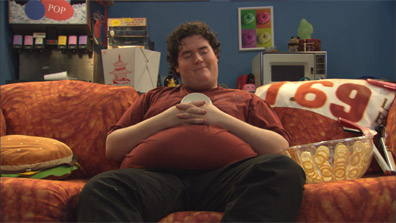
Jack rests on his hamburger couch after finishing
a delicious meal
The focal point, as in most
American living rooms, is the couch. Originally conceived as
a giant peanut butter and jelly sandwich by Eisner, Culpepper’s
vision of a mound of ground beef eventually won out. Meat -
especially raw meat - became a design theme.
"Half of the crew didn’t
even realize the pattern on the couch was ground beef until
we pointed it out," recalled David Workman, the Executive Producer.
"It was blatant and subtle at the same time."
The set incorporated meat
everywhere; in addition to the couch there was a transparent
clock stuffed with meat, a hamburger painting, a hamburger lamp,
a beef cuts poster, hamburger pillows, a "chili moat", hamburger
candles, and, of course, the hot dog rotisserie.
The dripping meat clock was
disgusting,’ recalls Angel (Pumpkin). "It definitely had serial
killer origins."
"We even had a parking meter
with stand that had been modified and filled with ground beef!"
laughed Eisner "It was one of the incongruous touches we added
to make the 're-creation' of the era seem more real - by being
flawed."
Cheese was a prominent food
and the source of inspiration for the "cheese chair" and parmiaganno
round side tables.
Eisner and Culpepper collaborated
on all aspects of production design from concept to shopping
for the meat - and muffins.
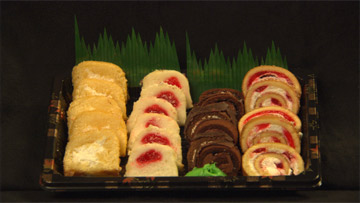
Snack-cake sushi or "snushi" is one of Eisner’s
unique creations for the film
"There are a lot of odd details
to discover in this film. Everywhere you look you can find something
unique to the era of the Muffin Men," concluded Eisner. "Designing
their world was a lot of fun."
|